Pawan Purohit
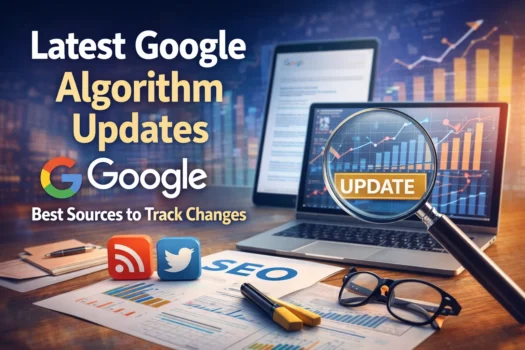
Google’s search algorithm is one of the most powerful and mysterious systems on the internet. It decides which website shows up first when someone types a query, and which one gets buried on page 5. If you are a blogger, content creator, or website owner, staying on top of Google algorithm updates is not optional. It is survival.
In this updated guide, I’ll walk you through:
- What Google algorithm updates are and how they work
- A complete timeline of major Google updates from 2022 to 2026
- The latest Google algorithm update (March 2026)
- How AI Overviews and E-E-A-T are reshaping SEO
- The best trusted sources to track every Google update
- Actionable tips to protect your rankings
- FAQs answered clearly
What Is a Google Algorithm Update?
Google’s algorithm is a set of complex ranking systems that evaluate billions of web pages to decide which ones are most useful for a given search query. Google does not keep this algorithm static; it constantly improves and changes it.
These changes are called Google Algorithm Updates. Some updates are small and happen quietly in the background. Others are major, announced publicly, and can cause massive shifts in rankings across the internet.
Google broadly divides its updates into two categories:
Core Updates: These are broad, sweeping changes to Google’s main ranking systems. They affect how Google evaluates content quality, relevance, and trustworthiness across the entire web. Google announces these officially, and they typically take 2 to 4 weeks to fully roll out.
Specific / Targeted Updates: These focus on specific areas like spam detection, product reviews, helpful content, link schemes, or site reputation abuse. They happen more frequently, and some are not officially announced.
Key Fact: In 2024, Google confirmed 7 algorithm updates. In 2025, it confirmed only 4, but SEO tracking tools recorded dozens of unconfirmed ranking fluctuations throughout the year. Fewer confirmations does not mean fewer changes.
How AI Overviews Are Changing SEO in 2026
One of the biggest shifts in Google search right now is not just about rankings, it is about visibility in AI Overviews.
Google launched AI Overviews (formerly Search Generative Experience / SGE) in May 2024, powered by the Gemini model. These are AI-generated answer summaries that appear at the top of search results for many queries.
Why this matters for your blog:
- AI Overviews have been reported to cut organic CTR by over 60% on affected queries for standard-ranked results
- However, pages that are cited inside an AI Overview earn significantly more clicks than a traditional ranked result
- Being cited by Google’s AI requires structured, authoritative content with clear E-E-A-T signals
- Google has confirmed that AI Overviews are also affected by core updates, so a strong content quality strategy helps both traditional and AI search visibility
Practical tip: Structure your articles with clear headings, direct answers in the first paragraph of each section, and factual, well-sourced information. This makes it easier for Google’s AI systems to extract and cite your content.
Understanding E-E-A-T: The Most Important Signal in 2026
E-E-A-T stands for Experience, Expertise, Authoritativeness, and Trustworthiness. Google added the first “E” (Experience) in 2022, and since then, it has become the single most important framework for evaluating content quality.
The March 2026 core update has extended E-E-A-T evaluation across all content types, not just health, finance, or legal (YMYL) pages.
Here is what E-E-A-T means in practical terms for bloggers:
- Experience: Does your content show real, first-hand knowledge? Google’s systems can detect the difference between someone who has actually used a product or visited a place versus someone who summarised others’ descriptions.
- Expertise: Is the author knowledgeable about the topic? Linking your articles to author profiles with credentials, published work, or domain expertise helps.
- Authoritativeness: Is your site recognised as an authority in its topic area? Topical depth (covering a subject thoroughly across many related articles) builds authority over time.
- Trustworthiness: Is your content accurate, up-to-date, and honest? Citing sources, displaying clear authorship, having a privacy policy, and maintaining factual accuracy all contribute.
Best Sources to Track Google Algorithm Updates in 2026
You cannot track every Google update yourself, but these trusted sources do it for you. Bookmark all of them.
1. Google Search Central (Official)
URL: developers.google.com/search/updates/core-updates
This is the only official source from Google itself. Every confirmed core update is announced here first. Google’s documentation explains how core updates work, what to do if you are affected, and what questions to ask about your own content. Always start here.
Also, check the Google Search Status Dashboard at status.search.google.com for real-time rollout status.
2. Search Engine Roundtable
URL: seroundtable.com/category/google-updates
Run by Barry Schwartz, one of the most respected and fastest reporters in the SEO industry. Search Engine Roundtable covers every confirmed and unconfirmed update, with community chatter, webmaster discussions, and date-accurate tracking. If something is happening in Google search, Schwartz will have a post about it within hours.
3. Search Engine Land
URL: searchengineland.com/library/platforms/google/google-algorithm-updates
One of the oldest and most authoritative SEO news publications. Their algorithm update library is a comprehensive timeline of every major Google change. They also publish in-depth analysis, recovery guides, and year-in-review roundups.
4. Semrush Sensor + Algorithm Update History
URL: semrush.com/blog/google-algorithm-update/
Semrush provides two valuable tools: a written history of confirmed updates and a live Semrush Sensor that tracks SERP volatility daily across 25+ categories. If the Sensor shows high volatility (7+), something is likely happening in Google search. Essential for any SEO professional.
5. Moz Google Algorithm Change History
URL: moz.com/google-algorithm-change
Moz has maintained a detailed archive of Google algorithm changes since the early 2000s,, covering everything from the original Panda and Penguin updates to the latest 2026 core updates. Their write-ups include in-depth analysis, case studies, and actionable SEO advice.
6. Search Engine Journal
URL: searchenginejournal.com/google-algorithm-history/
SEJ publishes fast, detailed coverage of every Google update, including rollout timelines, impact analysis, industry-specific effects, and practical recovery advice. Their team includes multiple writers who monitor updates across different niches.
7. Similarweb Blog (formerly RankRanger)
URL: similarweb.com/blog/marketing/seo/google-algorithm-updates/
Similarweb (which now owns RankRanger) tracks algorithm changes using visual volatility graphs with source links for deeper reading. Great for getting a quick visual overview of when major shifts happened and how severe they were.
8. Rank Math Google Updates Tracker
URL: rankmath.com/google-updates/
If you use Rank Math as your WordPress SEO plugin, their updates tracker is a clean, date-organised list of every confirmed and notable unconfirmed update. Practical and easy to browse.
9. Ahrefs Blog
URL: ahrefs.com/blog
Ahrefs regularly publishes detailed post-update analyses using its enormous keyword and traffic database. If you want to understand the real-world traffic impact of a core update across different niches, Ahrefs’ data-backed articles are excellent.
How to Protect Your Blog From Google Algorithm Updates
Tracking updates is important. But protecting your blog from negative impact is even more important. Here is what works consistently:
- Write for people first, not search engines. Google has repeated this in every core update guidance document. Content that genuinely answers a question, shares real experience, and adds value will hold up across updates.
- Keep your content fresh. Outdated articles signal low quality. Set a regular schedule to review and update your top-performing content with current information, new examples, and updated statistics.
- Build topical authority. Instead of writing one broad article on a topic, cover that topic deeply across multiple related posts. A blog that thoroughly covers a niche earns more trust from Google than one that touches many topics lightly.
- Show who you are. Google’s author entity signals are growing in importance. Add a proper author bio, link your content to your professional profile, and be transparent about who is writing what and why.
- Fix technical basics. Core Web Vitals, mobile-friendliness, page speed, and crawlability still matter. Google will not rank slow, broken pages over fast, clean ones, regardless of content quality.
- Do not panic-edit after every update. Google explicitly recommends waiting until at least one week after a rollout completes before analysing your performance. Making rapid changes mid-rollout can do more harm than good.
Frequently Asked Questions (FAQ)
Q: What is the latest Google algorithm update in 2026? A: The latest is the March 2026 Core Update, which began rolling out on March 27, 2026. It is the first broad core update of 2026 and is expected to take up to two weeks to fully complete. It targets content originality, E-E-A-T signals, and scaled AI-generated content without human oversight.
Q: How often does Google release algorithm updates? A: Google makes thousands of small changes every year. Major confirmed core updates typically happen 3–5 times per year. In 2024, Google confirmed 7 updates. In 2025, it confirmed 4. Google has also stated that it releases smaller, unannounced core updates between major ones.
Q: Does AI-generated content get penalised by Google? A: Google does not penalise AI-generated content by default. What Google penalises is low-quality, unhelpful content, whether written by AI or humans. AI content that is produced at scale without meaningful human review, editing, and fact-checking is what gets hit by spam updates and core updates. AI used as a drafting tool with strong human editorial oversight can perform well.
Q: My rankings dropped after a core update. What should I do? A: First, wait until the rollout is finished before concluding. Then use Google Search Console to identify which pages dropped and for which queries. Ask yourself: Does this content genuinely help the person searching? Is it the most useful answer available for that query? Could it be more thorough, more original, or better sourced? Focus on improving those specific pages. Major recovery usually happens at the next core update.
Q: What is E-E-A-T, and why does it matter? A: E-E-A-T stands for Experience, Expertise, Authoritativeness, and Trustworthiness. It is the framework Google uses to evaluate content quality. Since the March 2024 core update, it has been embedded directly into Google’s core ranking algorithm and evaluated continuously. Every blogger and content creator should understand and apply E-E-A-T principles across their entire site.
Q: What is the difference between a core update and a spam update? Core update recalibrates how Google evaluates content quality and relevance across the entire web. It does not target specific rule violations; it resets the quality standard. Spam update specifically targets websites engaging in manipulative practices such as link schemes, cloaking, parasite SEO, and the use of scaled spam content. Both affect rankings, but for different reasons.
Q: Where is the best place to check for the latest Google algorithm update right now? The fastest and most reliable sources are the Google Search Status Dashboard (status.search.google.com) for official confirmation and Search Engine Roundtable (seroundtable.com) for fast community-level reporting. For in-depth analysis, Search Engine Land and Search Engine Journal are the best.
Q: How do AI Overviews affect my blog’s traffic? AI Overviews can reduce organic click-through rates significantly on queries they cover. However, if your content is cited within an AI Overview, it can generate more clicks than a standard ranked position. To increase your chances of being cited, focus on clear E-E-A-T signals, structured content with direct answers, and factual accuracy backed by sources.
Final Words
Google’s algorithm will keep evolving; that is the one thing you can count on. The March 2026 Core Update is the latest chapter in a years-long shift toward rewarding genuine, original, people-first content and away from tactics that game the system.
The good news: if you are creating real content based on real experience and knowledge, you are already on the right side of every Google update. The bloggers and site owners who are winning in 2026 are not chasing shortcuts; they are building something sustainable.
Bookmark the sources listed above, check in after every major update, and keep creating content worth ranking for. That is the only SEO strategy that has ever worked long-term.