
 Pawan Purohit
5G is no longer the future; it is the present, and it is reshaping the world faster than any previous mobile generation. As of 2025, 5G has crossed 2.25 billion connections worldwide, growing four times faster than 4G did at the same stage. It is live in over 100 countries, covering 55% of the global population. South Korea, which launched the world’s first commercial 5G network in 2019, now enjoys near-universal nationwide coverage. China has surpassed 1 billion 5G connections. The US, Japan, and most of Western Europe have moved well past the rollout phase into everyday mainstream use.
India, too, has become a major part of this global story, the second-largest 5G market in the world by subscriber count, with 500,000+ base stations and coverage in 99.9% of districts.
If you are still wondering what exactly 5G is, how it works, where the world stands, and what it means for you, whether you are in a metro city or a pahadi village, this guide explains everything, from the basics to what comes after 5G.
What is 5G Technology?
5G stands for fifth-generation mobile network, the successor to 4G LTE. Just as 4G made mobile video streaming and app-based services mainstream, 5G is designed to take connectivity to a whole new level: faster speeds, near-zero lag, and the ability to handle millions of devices simultaneously.
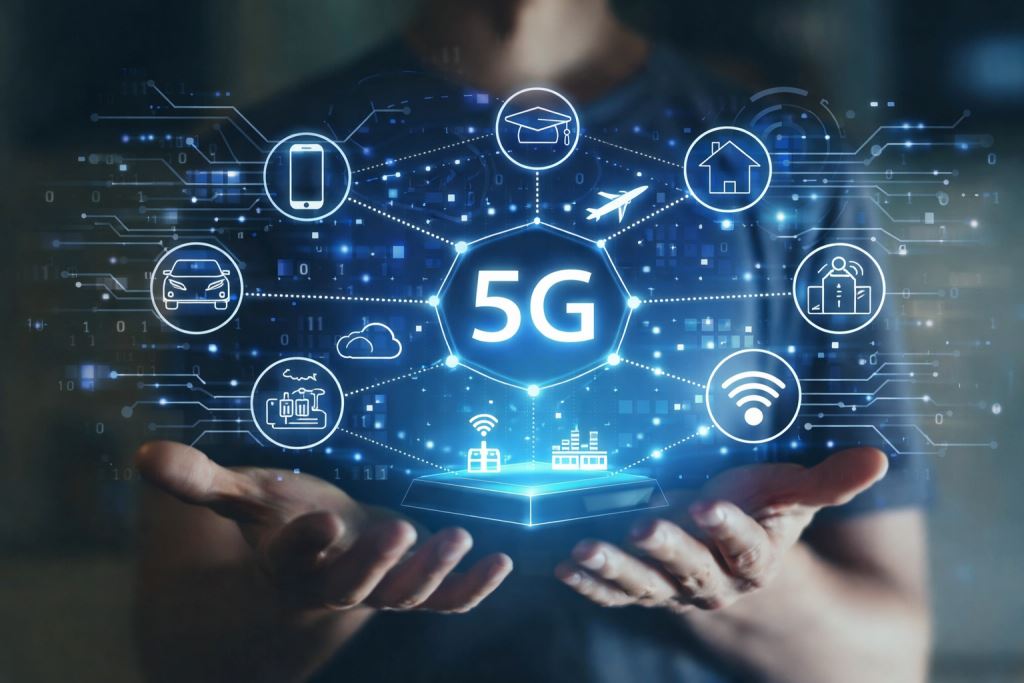
In simple terms, 5G is a software-defined wireless network capable of delivering:
- Download speeds of up to 20 Gbps under ideal conditions
- Ultra-low latency of as little as 1 millisecond (for comparison, 4G averages 30–50 ms)
- Massive device density up to 1 million devices per square kilometre
Because it is largely software-based, 5G is more flexible than older networks. It can be split into “slices” dedicated virtual lanes for different uses, like one slice for hospitals and another for gaming, all running on the same physical infrastructure.
How Does 5G Technology Work?
5G networks work using five core technologies working together:
1. mmWave (Millimetre Wave) Millimetre waves operate at very high frequencies (24–100 GHz), allowing massive amounts of data to move at speeds up to 1 Gbps. The trade-off is range; mmWave signals don’t travel far and struggle through walls. This is why mmWave is mainly used in dense urban areas, stadiums, and airports.
2. Small Cells Because mmWave has a limited range, 5G deploys thousands of small, low-power mini towers placed close together, on lampposts, rooftops, and buildings. These small cells fill coverage gaps and ensure a continuous, uninterrupted signal even in crowded areas.
3. Massive MIMO MIMO stands for Multiple Input, Multiple Output. A traditional 4G tower has around 12 antennae. Massive MIMO 5G towers can have 64, 128, or even 256 antennae on a single unit, dramatically increasing how much data can flow simultaneously.
4. Beamforming Instead of broadcasting a signal in all directions (like a loudspeaker), beamforming directs the signal precisely toward a specific user, like a spotlight rather than a floodlight. This reduces interference, improves speed, and makes the network more efficient.
5. Full Duplex Traditional networks had to take turns to send, then receive, then send again. Full Duplex allows simultaneous two-way communication on the same frequency, essentially doubling capacity and reducing delays.
5G SA vs NSA: What Is the Difference?
If you follow telecom news in India, you have likely heard the terms Standalone (SA) and Non-Standalone (NSA) 5G. Here is what they actually mean.
NSA (Non-Standalone) 5G uses the existing 4G core network as a backbone, with 5G radio on top. It is faster and cheaper to deploy because operators reuse 4G infrastructure. The downside is that it does not deliver the full potential of 5G, particularly in terms of ultra-low latency and network slicing. Airtel’s 5G Plus network in India runs on NSA architecture.
SA (Standalone) 5G is built on a completely new, dedicated 5G core. It is the “true 5G”, offering the full feature set including network slicing, ultra-low latency, and AI-native capabilities. It costs more to build but delivers far greater long-term value. Reliance Jio chose the SA path from day one, making it the only Indian operator on a full SA 5G network.
Think of it this way: NSA is like building a new road but still using old traffic signals. SA is a fully redesigned road with intelligent systems built in from scratch.
Benefits of 5G Technology
- Speed: Peak speeds of up to 20 Gbps, roughly 100x faster than the average 4G
- Low latency: Response times as low as 1 ms, enabling real-time applications like remote surgery and autonomous vehicles
- More connections: Supports a massive number of IoT devices simultaneously, critical for smart cities and smart agriculture
- Network efficiency: 5G uses the spectrum more efficiently, meaning less congestion even in crowded areas
- New industries: Enables capabilities that simply were not possible on 4G AR/VR at scale, industrial automation, connected healthcare
5G Around the World: The Global Picture in 2026
Understanding 5G in India makes more sense when you see where it fits globally.
The numbers: By 2024, global 5G connections reached 2.25 billion, up from essentially zero in 2019. Forecasts project this will grow to 8.3 billion by 2029, representing 59% of all wireless connections on Earth. The 5G services market, valued at around $125 billion in 2024, is forecast to grow into one of the largest technology markets in history over the next decade.
Who leads: East Asia dominates. China alone has surpassed 1 billion 5G connections, leading the world in both scale and speed of deployment. In mainland China, over 90% of new smartphone shipments are already 5G-capable. South Korea, the first country to launch commercial 5G in April 2019, now has near-universal nationwide 5G coverage and consistently ranks among the fastest networks globally with median 5G speeds above 350 Mbps. Japan is close behind, with 5G SA networks maturing and 5G Advanced features rolling out.
North America & Europe: North America has the highest 5G subscription penetration globally, expected to reach 79% by the end of 2025, led by T-Mobile, AT&T, and Verizon in the US. Western Europe is moving steadily, with countries like Denmark, the Netherlands, and Switzerland achieving 98–99% coverage. The US shut down 3G in 2022, and most carriers are now phasing out 2G entirely, clearing spectrum for 5G expansion.
Middle East: The UAE and Saudi Arabia rank among the world’s fastest 5G networks. The UAE recorded median 5G download speeds of 546 Mbps in 2025, comparable to home broadband in many countries.
The divide: Not everyone has benefited equally. While over 80% of the population in high-income countries now has 5G access, fewer than 5% in low-income countries do. Africa, parts of South Asia, and rural regions of Latin America remain significantly underserved. This global digital divide is one of the defining telecom challenges of this decade, and it is why rural 5G strategies (like India’s) matter far beyond national borders.
The trend: Countries that led on 5G are already phasing out 3G and beginning 5G Advanced (also called 5G-A) trials, a halfway step between 5G and 6G. The world is not waiting.
5G in India: Where Things Stand in 2026
India’s 5G story is one of the fastest telecom rollouts in history. Here is a snapshot of where each major operator stands:
Reliance Jio
Jio launched commercial 5G in October 2022 and went all-in with Standalone architecture. As of early 2026, Jio has approximately 213 million+ 5G subscribers, making it one of the largest 5G operators in the world. Jio also bid for and won the 700 MHz spectrum band, a low-frequency band that offers deep building penetration and wide area coverage, making it especially valuable for rural and semi-urban deployments. Jio’s 5G penetration among its subscriber base has crossed 42%.
Bharti Airtel
Airtel’s 5G Plus network covers 6,500+ towns across India, including remote regions of Northeast India, running on NSA technology. Airtel delivers consistent speeds of 500–950 Mbps, depending on location and device. With around 153 million 5G subscribers, Airtel focuses on premium quality and indoor coverage. Its 5G penetration rate is also around 42%.
Vodafone Idea (Vi)
Vi is the slowest of the three in its 5G rollout, with commercial 5G available in select cities. Coverage spans approximately 1,200 towns as of mid-2025, but the network is expanding with AI-optimised infrastructure. Vi’s financial challenges have slowed aggressive investment, though the operator is catching up.
The Big Picture
India now has over 518,000 5G base stations nationwide, with 5G available in 99.9% of districts, reaching an estimated 85% of the population. India has become the second-largest 5G market in the world by subscriber count. 5G data traffic is expected to surpass 4G traffic in India by early 2026.
5G and AI – The Intelligent Network
5G and Artificial Intelligence are increasingly being built together, not deployed separately. This convergence is changing what a mobile network actually does.
Modern 5G base stations are being powered by AI to predict traffic patterns, optimise signal routing in real time, and reduce energy consumption, a capability known as AI-native networking. Rather than responding to congestion after it happens, these intelligent base stations anticipate and prevent it.
Edge computing takes this further. Instead of sending all data to a distant cloud server, edge computing processes data at or near the source, at the base station or a local data centre. This is what makes low-latency applications practical. Tele-surgery trials on Jio’s network in Mumbai and Hyderabad are already using this architecture. Smart city projects in Pune and Bhopal are using 5G with AI-based analytics for real-time traffic management and public safety.
For India specifically, AI-powered 5G also means smarter spectrum management, allowing the network to dynamically shift coverage from low-demand to high-demand areas, improving service in both urban centres and remote zones.
5G for Rural India – What It Could Change
For audiences in villages and smaller towns, in Uttarakhand’s hill regions or Rajasthan’s desert communities, 5G may feel distant. But the rollout is making real inroads, and the implications are significant.
Jio’s SA 5G using the 700 MHz band is designed for exactly this challenge. Low-frequency signals travel farther and penetrate buildings better, making them suited for rural coverage. Airtel is also powering remote health centres in Himachal Pradesh with AI-assisted diagnostics over 5G.
Some early signs of 5G’s rural impact:
- Virtual classrooms powered by 5G are live in over 700 rural schools across India, enabling cloud learning and real-time video lessons
- Telemedicine is enabling remote consultations and diagnostic support in areas with no specialist doctors nearby
- Smart agriculture – soil monitoring, weather alerts, drone-based surveillance, all become practical over high-speed, low-latency 5G
- Fixed Wireless Access (FWA) – like JioAirFiber brings broadband-quality internet to homes without laying fibre cables, critical in mountain villages where underground cabling is expensive or impossible
The honest picture is that deep rural India, remote gaon, high-altitude villages, is still years away from true 5G. But the trajectory is clearly in that direction, and operators are investing accordingly.
Looking Ahead: What is 6G?
Even as 5G expands, India and the world are already working on what comes next.
6G (Sixth Generation) is expected to arrive globally around 2030. India’s government released the Bharat 6G Vision document in March 2023, setting an ambitious target to not just deploy 6G but to be a global leader in designing it, a sharp contrast to previous generations, where India was primarily a consumer of imported technology.
Key 6G capabilities being developed include:
- Data speeds up to 1 Terabit per second (1,000x faster than peak 5G)
- Latency below 1 millisecond – enabling truly real-time machine-to-machine interaction
- AI-native networks – where intelligence is built into the network architecture itself, not added on top
- Integrated sensing – the network itself becomes a sensing layer, detecting physical movement, environment, and context
- Seamless satellite + terrestrial coverage to reach every corner of the globe
India aims to run 6G trials between 2026 and 2028, with commercial deployment around 2030. Unlike 5G, where India arrived as a fast follower, the Bharat 6G strategy is to help write the global standards, contributing to ITU’s IMT-2030 framework and developing indigenous solutions via 100 dedicated 5G/6G labs at premier institutions.
Frequently Asked Questions
Q. Which country has the best 5G in the world? South Korea and the UAE consistently rank at the top for 5G speed and coverage. South Korea launched the world’s first commercial 5G network in 2019 and now has near-universal coverage with speeds above 350 Mbps. The UAE recorded a median 5G speeds of 546 Mbps in 2025. China leads in sheer scale, having crossed 1 billion 5G connections. India ranks second globally by subscriber count.
Q. What is 5G technology in simple words? 5G is the fifth generation of mobile network technology. It provides much faster internet speeds, much lower lag (latency), and the ability to connect far more devices at once compared to 4G. It powers everything from faster phone internet to smart cities and connected hospitals.
Q. How does 5G technology work? 5G uses a combination of technologies, millimetre wave frequencies for speed, small cell towers for coverage, Massive MIMO antennae for capacity, beamforming for targeted signal delivery, and Full Duplex for simultaneous two-way communication. Together, these allow data to travel faster and more efficiently than any previous network.
Q. What is 5G speed in India in 2026? In major metros, average 5G speeds range from 850 Mbps to 1.2 Gbps on Jio’s network. Airtel delivers 500–950 Mbps across its coverage area. Tier-2 cities see slightly lower but still significantly faster speeds than 4G.
Q. Is 5G available in rural India? 5G is expanding into rural India, primarily through Jio’s Standalone network using the 700 MHz band, which travels farther and penetrates buildings better. Full rural coverage will take time, but FWA products like JioAirFiber are already bringing 5G-powered broadband to homes without fibre cables.
Q. What is the difference between 5G SA and 5G NSA? SA (Standalone) 5G runs on a completely new 5G core network, delivering the full benefits of 5G, including ultra-low latency and network slicing. NSA (Non-Standalone) 5G is built on top of existing 4G infrastructure, faster to deploy, but does not offer the complete 5G feature set. In India, Jio runs SA while Airtel runs NSA.
Q. When will 6G come to India? India aims to commercially deploy 6G by 2030, with field trials expected between 2026 and 2028. The government’s Bharat 6G Vision targets making India a global leader in 6G design and standards, not just a user of the technology.
Q. Do I need a new phone for 5G? Yes. 5G requires a 5G-enabled device. However, affordable 5G smartphones are now available in India starting under ₹10,000–15,000, making the upgrade accessible for most users.


